
NEXTREAT Laboratories performs GLP compliant boiling point determination according to OECD 103 and OPPTS 830.7220, based on either one of these methods:
- Differential scanning calorimetry (DSC) either with pierced crucible (standard) or with sealed crucible
- Capillary boiling point determination
By DSC measurement, the temperature or temperature range of the phase transition from the liquid to the vapor state is determined using the differential scanning calorimetry method. A small amount of the test item was inserted into the furnace of the device and the transition point(s) is determined based on measuring the heat flow while raising the temperature. The heat flow in and out of a sample and a reference is measured as a function of temperature as the sample is heated. When the sample undergoes a transition involving a change in enthalpy (endothermic on boiling), that change is indicated by a departure from the base line of the heat flow record. The difference in energy input necessary to maintain identical temperatures between the substance and the reference is recorded. The measurement signal is the energy absorbed by or released by the sample.
For REACH regulatory purposes, the exact boiling point determination does not need to be conducted, if the melting point is above 300°C or if the substance decomposes before boiling.
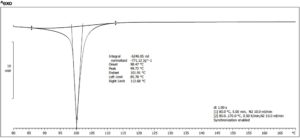
Exemplary result of a DSC measurement:
Applicable guidelines:
- Organisation for Economic Co-operation and Development (OECD), Guidelines for Testing of Chemicals, Guideline No. 103, “Boiling Point”, adopted July 27, 1995
- Product Properties Test Guideline OPPTS 830.7220 “Boiling Point/Boiling Range” of the United States Environment Protection Agency (EPA), August 1996